
Space exploration is often celebrated as a story of triumph—rockets launching cleanly, probes sending back breathtaking images, and astronauts returning home as heroes. But behind those victories lies a quieter, darker reality. Some spacecraft simply disappeared.
No explosion.
No final transmission.
No clear explanation.
They vanished into the void, leaving behind questions that still haunt engineers, scientists, and historians.
When Space Goes Silent
In space exploration, silence is terrifying. Spacecraft constantly transmit data—telemetry that confirms position, health, and purpose. When that signal cuts out unexpectedly, it’s not just a technical problem. It’s a mystery unfolding millions of miles away, beyond the reach of rescue or repair.
One moment, everything is normal.
The next, nothing.
Mars Probes That Never Spoke Again
Mars has claimed more failed missions than any other planet.
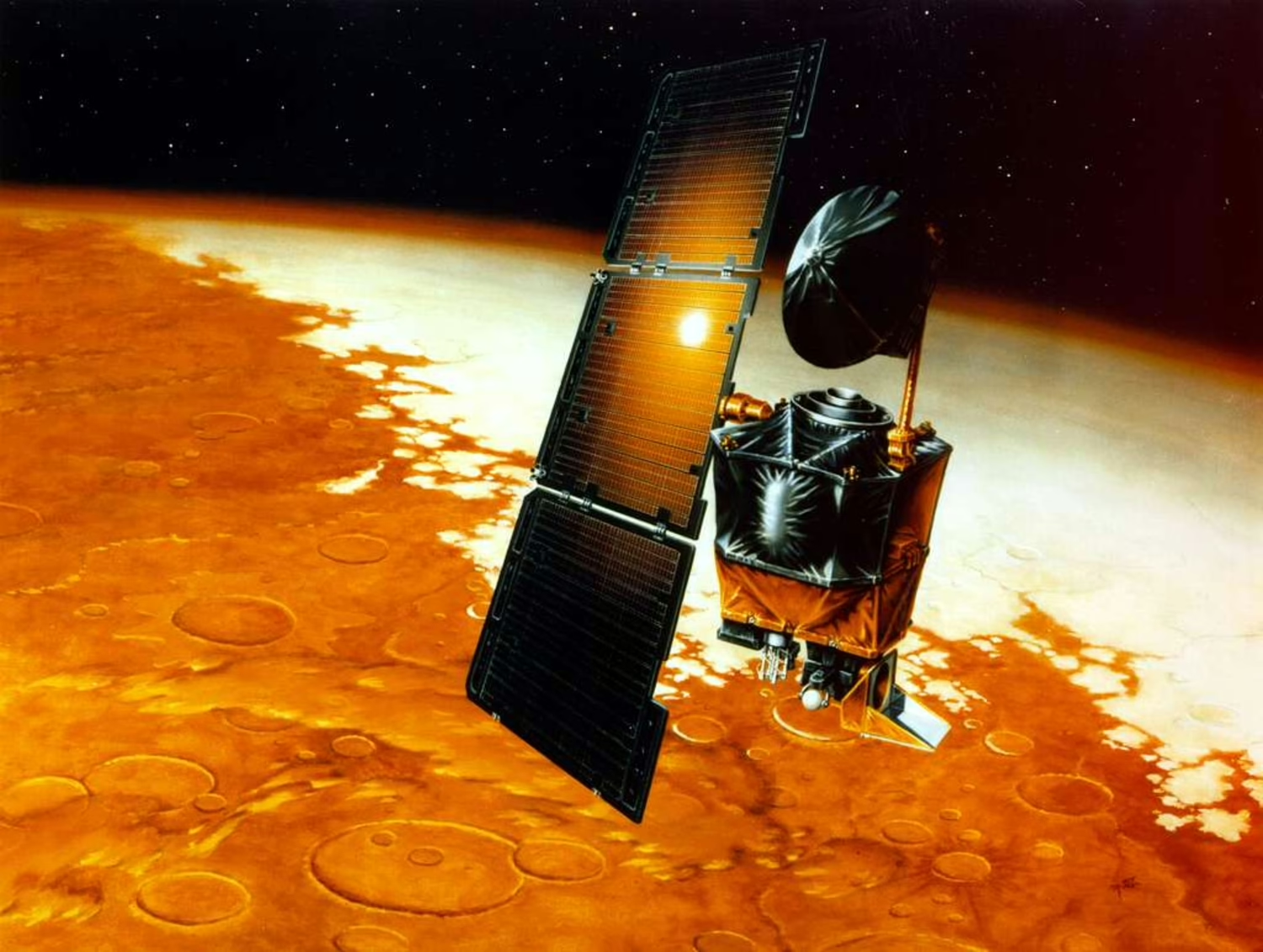
In 1999, Mars Climate Orbiter vanished because of a simple but catastrophic error: one engineering team used metric units while another used imperial units. The spacecraft descended too low into Mars’ atmosphere and burned up.
There was no final image.
No last warning.
Just silence.
A few months later, Mars Polar Lander stopped communicating during its descent. Investigators believe its landing legs triggered sensors too early, shutting off the engines while it was still in the air. It likely slammed into the surface at full speed.
To this day, its remains have never been conclusively identified.
The Soviet Probes Lost to Venus
During the Cold War, the Soviet Union launched dozens of missions toward Venus. Many never made it.
Some vanished shortly after launch. Others transmitted data briefly—then went quiet forever. The extreme heat, crushing pressure, and corrosive atmosphere of Venus destroyed spacecraft faster than engineers could adapt.
One probe, Kosmos 482, failed to escape Earth’s orbit in 1972. Part of it burned up in the atmosphere, but a heavy descent module likely survived reentry and may still be somewhere on Earth—never found, never confirmed.
A spacecraft meant for another planet became a ghost on our own.
The Lunar Missions That Faded Away
Even the Moon, our closest neighbor, has claimed its share of missing spacecraft.
Several early lunar landers lost contact during descent, crashing or shutting down before they could transmit images. Some were tracked only until the final seconds, then vanished behind the Moon’s surface.
Without atmosphere, weather, or erosion, their remains could still be there—silent relics scattered across the lunar dust.
We just don’t know where.
When Signals Defy Explanation
Not all disappearances are easily explained by physics or engineering.
In 1967, Surveyor 3 landed successfully on the Moon and transmitted data for years. When Apollo 12 astronauts visited the site in 1969, they found the probe intact—but lifeless. It had stopped transmitting without any obvious damage.
More recently, small CubeSats and deep-space probes have sent corrupted data, strange signals, or brief bursts before going dark—leaving engineers uncertain whether they malfunctioned, were damaged by radiation, or encountered something unexpected.
Space is not empty. It’s hostile, unpredictable, and largely unknown.
Why Spacecraft Vanish So Easily
Space missions operate on razor-thin margins. A single flipped bit caused by cosmic radiation can alter software. A micrometeoroid smaller than a grain of sand can destroy a critical component.
And once something goes wrong, distance becomes the enemy.
There are no tow trucks in space.
No emergency landings.
No second chances.
When a spacecraft stops responding, all that remains is speculation and data fragments.
The Psychological Impact of Lost Missions
For the engineers and scientists who build these spacecraft, disappearance isn’t just a technical failure—it’s an emotional loss.
Years of work, billions of dollars, and countless hopes vanish in an instant. Some teams spend decades replaying data, searching for the moment things went wrong.
Others never find answers.
That uncertainty lingers longer than failure ever could.
Are Some Mysteries Meant to Stay Unsolved?
Most vanished spacecraft likely met mundane ends: software errors, mechanical failures, environmental extremes. But the absence of evidence leaves room for imagination.
Did a probe encounter an unknown phenomenon?
Did it drift silently through space, still intact but unheard?
Could some lost spacecraft still be out there, orbiting stars, carrying humanity’s technology into the dark?
We don’t know.
Final Thought
Every spacecraft that never came back reminds us that space exploration is not safe, predictable, or fully controllable. It is a gamble against distance, time, and the unknown.
Some missions succeed and rewrite textbooks.
Others vanish without a trace.
And somewhere, drifting between planets or buried beneath alien soil, are machines built by human hands—still carrying our ambition, curiosity, and unanswered questions into the endless silence of space.