
Deep in some of the most inhospitable regions on Earth, archaeologists have uncovered ruins that challenge everything we think we know about human history. These aren’t buried near rivers or fertile valleys—where civilizations are supposed to form. They’re found in deserts, jungles, mountains, and underwater locations where survival itself seems impossible.
And that’s exactly why they shouldn’t exist.
Yet they do.
Cities in the Wrong Places
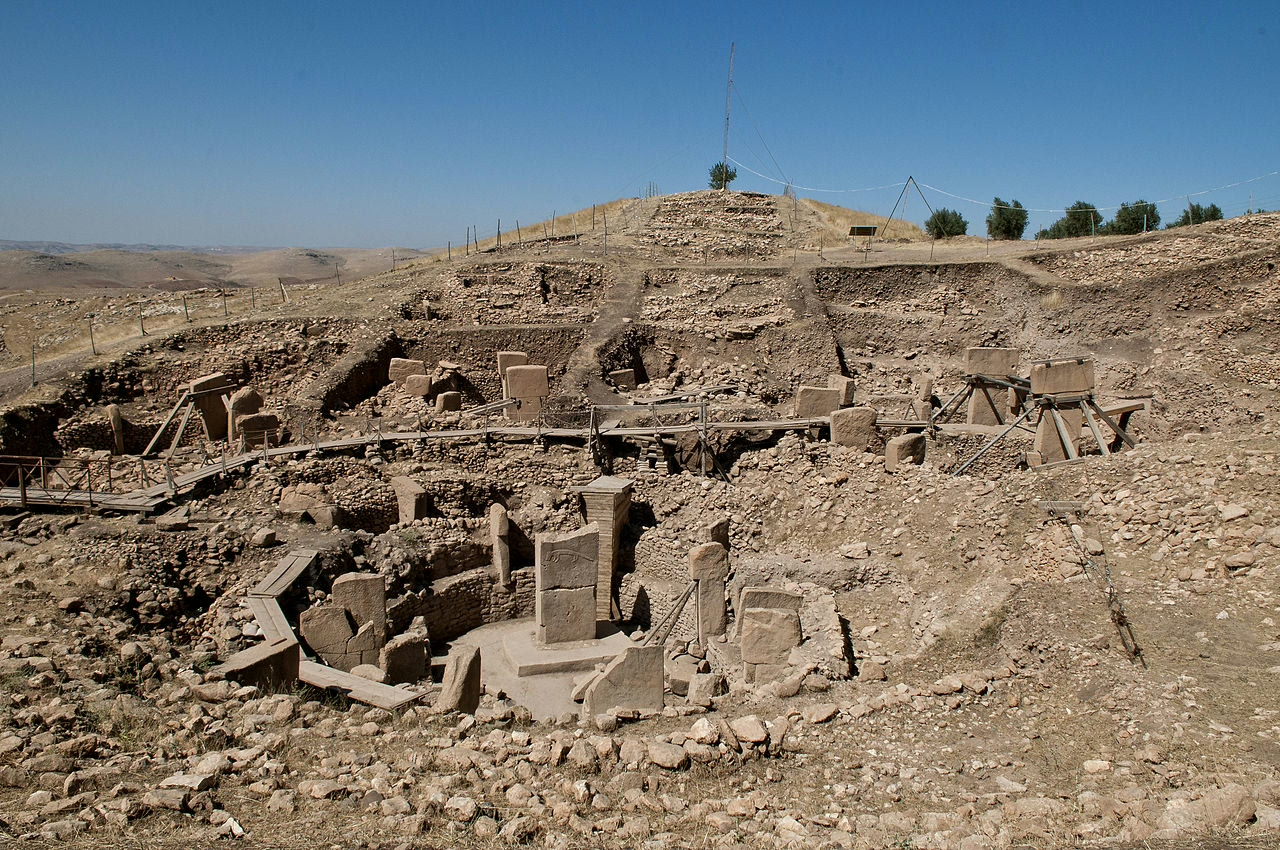
Conventional archaeology teaches that advanced civilizations arise near stable water sources, arable land, and predictable climates. But discoveries like Göbekli Tepe in Turkey shattered that rule. Built over 11,000 years ago—before agriculture, before metal tools—this massive stone complex required organization, planning, and labor on a scale historians once believed impossible for hunter-gatherers.
Who built it?
Why did they bury it deliberately?
And how did they coordinate such precision without written language?
Science still doesn’t have full answers.
Then there’s Nan Madol, an ancient city built on artificial islands in the Pacific Ocean using basalt stones weighing several tons each. No cement. No metal tools. No clear method for transporting stones across water.
Local legends claim the stones were floated through the air.
Scientists prefer silence.
Ruins Hidden Where Humans Couldn’t Survive
In the Amazon rainforest, laser scanning technology has revealed evidence of vast urban networks beneath the dense jungle canopy—cities with roads, canals, and populations rivaling those of medieval Europe. These areas were long believed to be untouched wilderness.
If millions lived there, where did they go?
More unsettling still are ruins found in high-altitude regions like the Andes, where oxygen levels are dangerously low. The precision-cut stones of sites like Puma Punku fit together with such accuracy that even modern machinery would struggle to replicate them.
No written records explain who built them—or how.
Technology Without a Timeline
Many of these lost cities feature construction techniques that appear far ahead of their time:
- Stones cut with laser-like precision
- Structures aligned with astronomical events
- Engineering that resists earthquakes better than modern buildings
These aren’t primitive experiments. They’re finished systems.
Which raises an uncomfortable possibility: human history may be far older—and far more complex—than we’re willing to admit.
Why Science Struggles With These Discoveries
The problem isn’t evidence. It’s interpretation.
Accepting these ruins at face value would mean rewriting timelines, questioning long-held assumptions, and admitting that advanced knowledge may have existed—and vanished—long before recorded history.
That’s not an easy pill for science to swallow.
So instead, many of these sites remain understudied, underfunded, or quietly debated behind academic doors.
The Question That Won’t Go Away
If civilizations existed where none should have, what happened to them?
Natural disasters?
Climate collapse?
Human conflict?
Or something we haven’t identified yet?
The lost cities remain—silent, precise, and out of place—waiting for answers humanity may not be ready to hear.