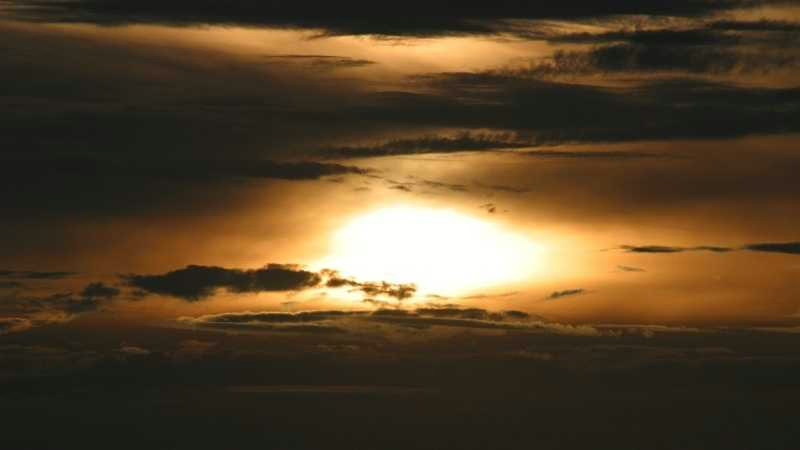
The Sun feels permanent. It rises every morning, sets every evening, and anchors life on Earth with unwavering reliability. Because of that, most people never imagine a world where the Sun almost vanishes. Yet, not long ago in cosmic terms, Earth came dangerously close to a solar event that could have changed life forever.
It wasn’t an explosion.
It wasn’t a collision.
It was something far more subtle—and far more terrifying.
The Solar Event Few People Talk About
In the early 19th century, astronomers noticed something strange. Sunspots—dark, cooler regions on the Sun’s surface—nearly vanished. For decades, the Sun entered an unusually quiet phase now known as the Dalton Minimum.
Solar activity dropped dramatically. Energy output weakened. The Sun didn’t disappear in the literal sense—but it dimmed just enough to push Earth toward chaos.
This period wasn’t long in solar terms, but for humans living through it, the consequences were devastating.
When the Sun Went Quiet, the World Went Cold
Between roughly 1790 and 1830, Earth experienced a noticeable global cooling trend. Winters grew longer and harsher. Summers became shorter and weaker.
Rivers across Europe froze solid.
Crops failed repeatedly.
Famine spread through vulnerable regions.
This era overlapped with the Little Ice Age, but the Dalton Minimum amplified its effects. Scientists now believe reduced solar radiation played a major role in disrupting Earth’s climate balance.
The Sun didn’t vanish—but it weakened just enough to remind humanity how dependent life is on its light.
A Planet Balanced on a Knife’s Edge
What makes this event so unsettling is how small the change was.
The Sun’s energy output dropped by less than one percent.
That tiny shift was enough to:
- Alter global weather patterns
- Expand glaciers
- Collapse agricultural systems
- Trigger food shortages across continents
Earth’s climate system is a fragile machine. When the Sun falters—even slightly—the ripple effects are enormous.
If the Sun had dimmed a little more, the consequences could have been catastrophic.
Could It Happen Again?
Solar cycles rise and fall naturally. Roughly every 11 years, the Sun shifts between high and low activity. Most cycles are harmless. But occasionally, the Sun enters extended quiet phases like the Dalton Minimum or the earlier Maunder Minimum.
Scientists still don’t fully understand why these prolonged solar lulls occur.
That’s the unsettling part.
Modern civilization relies on stable climate. Power grids, food production, satellite systems, and global trade all depend on predictable solar behavior.
A prolonged solar weakening today wouldn’t just cause cold winters—it could destabilize the entire planet.
The Other Way the Sun Could “Disappear”
There’s another nightmare scenario, far less subtle.
Massive solar storms—violent eruptions of charged particles—can temporarily overwhelm Earth’s magnetic shield. If powerful enough, they can disrupt satellites, knock out power grids, and black out communication systems.
In 1859, the Carrington Event caused telegraph systems to spark and fail worldwide. If a storm of that magnitude struck today, modern technology could be crippled for months—or longer.
In that moment, the Sun wouldn’t vanish visually.
But civilization as we know it might.
Why We Didn’t Notice How Close We Were
The people living during the Dalton Minimum didn’t know the Sun was the cause. They blamed bad harvests, harsh winters, or divine punishment.
Only centuries later did scientists connect the dots.
That’s what makes this story chilling: Earth came close to disaster without realizing it.
No alarms sounded.
No global warnings were issued.
The Sun simply grew quieter—and the planet suffered.
A Reminder Written in the Sky
The idea of the Sun disappearing feels impossible. But history tells a more fragile story.
Our star is stable—but not constant.
Powerful—but not predictable.
Life-giving—but capable of disruption.
The day the Sun almost disappeared wasn’t marked by noon darkness or panic in the streets. It unfolded slowly, quietly, and invisibly—until the consequences were unavoidable.
Final Thought
Earth didn’t survive because it was invincible.
It survived because the Sun recovered.
That should humble us.
The next time the Sun rises, remember this: the difference between life as we know it and global catastrophe isn’t a cosmic explosion—it’s a subtle change in the steady glow we’ve always taken for granted.