
The phrase light year sounds like time. It feels like time. It even tricks your brain into imagining clocks, calendars, and slow cosmic journeys. But here’s the twist: a light year isn’t time at all.
It’s distance.
And not just any distance—a distance so enormous that the human brain simply wasn’t built to imagine it.
What a Light Year Really Is
A light year is the distance light travels in one year. Light moves at about 300,000 kilometers per second (186,000 miles per second). In one year, that adds up to roughly 9.46 trillion kilometers (5.88 trillion miles).
That number already breaks most people’s sense of scale. We measure our lives in steps, minutes, and miles—not trillions.
If you tried to count that distance at one number per second, it would take over 300,000 years just to finish counting.
And that’s only one light year.
Why Your Brain Struggles With It
Human brains evolved to survive in small environments. We’re good at estimating distances across rooms, streets, or landscapes. But once numbers pass a certain size, our minds stop visualizing and start labeling.
At that point, “one million,” “one billion,” and “one trillion” feel emotionally similar—even though they’re vastly different.
A light year exists far beyond that mental cutoff.
Your brain doesn’t see a light year.
It just accepts the word and moves on.
Space Is Measured in Light Years Because Miles Fail
Distances in space are so massive that traditional units become meaningless.
- The Moon is about 1.3 light seconds away
- The Sun is about 8 light minutes away
- The nearest star system, Alpha Centauri, is 4.37 light years away
Even our galaxy—the Milky Way—is around 100,000 light-years wide.
Using miles or kilometers for these distances would require numbers so long they’d lose all practical value. Light years compress the incomprehensible into something usable.
But usable doesn’t mean understandable.
Looking at the Past Without Time Travel
Here’s where things get unsettling.
When you look at something one light year away, you’re seeing it as it was one year ago. If a star is 1,000 light-years away, you’re seeing it as it existed 1,000 years in the past.
Some stars you see in the night sky may already be dead.
You’re not seeing the universe as it is—you’re seeing a collection of ancient snapshots.
Every glance upward is a form of time travel.
How Big Space Really Gets
Let’s stretch the mind further.
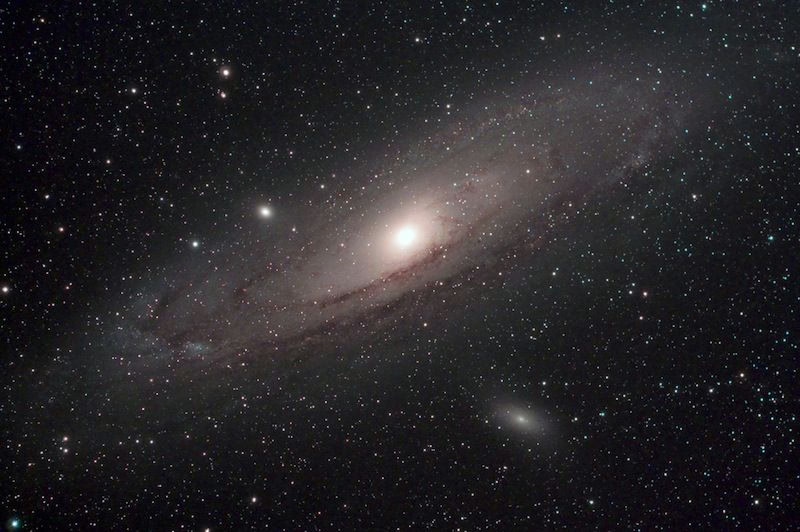
The Andromeda Galaxy, our nearest large galactic neighbor, is about 2.5 million light-years away. That means the light reaching Earth tonight began its journey before humans existed as a species.
Now zoom out more.
The observable universe is about 93 billion light-years across. That doesn’t mean the universe is only that big—it means that’s as far as light has been able to reach us since the beginning of time.
Beyond that? We don’t know.
The universe may be infinite—or just unimaginably larger.
Why “Imagine It” Breaks Down
Try this experiment:
Imagine driving at highway speed—60 miles per hour. At that speed, it would take over 17 million years to travel one light year.
Now imagine not stopping.
Not sleeping.
Not aging.
Your brain gives up.
This is where imagination fails—not because you’re not trying hard enough, but because your mind lacks evolutionary tools for these scales.
Light years exist in a realm beyond intuition.
Light Years and Human Insignificance
Light years quietly reshape how we see ourselves.
On Earth, borders feel important. Time feels urgent. Individual moments feel massive. But when placed against distances that take millions or billions of years to cross at light speed, human life becomes incredibly small.
That doesn’t make life meaningless.
It makes it rare.
Out of all that distance, all that darkness, all that empty space, you exist on a tiny planet orbiting an average star in a vast galaxy—thinking about light-years at all.
That’s not insignificant.
That’s astonishing.
Why We Still Try to Understand
Even though our brains can’t fully imagine light-years, we keep trying. We build telescopes. We send probes. We develop mathematics and physics to compensate for the limits of imagination.
Understanding doesn’t require emotional intuition—it requires curiosity. Light-years remind us that the universe doesn’t owe us comprehension. Yet, piece by piece, we reach for it anyway.
Final Thought
A light year isn’t just a distance—it’s a reminder of scale.
It tells us that reality is far larger than instinct, that time and space are deeply connected, and that human awareness stretches far beyond the environment it evolved in.
Your brain may never truly feel what a light year is.
But the fact that you can think about it at all?
That might be the most extraordinary distance of all.