They set out expecting nothing more than a familiar winter hike. The conditions were ideal for experienced trekkers: clear skies, crisp snow, and a stillness that only deep winter brings to the Norwegian mountains. The group moved steadily along the trail above the fjord, their spikes crunching rhythmically against the frozen ground. Below them, the water reflected the pale blue sky like glass.
It was meant to be routine.
Then someone noticed the smoke.

Smoke Where Nothing Should Be
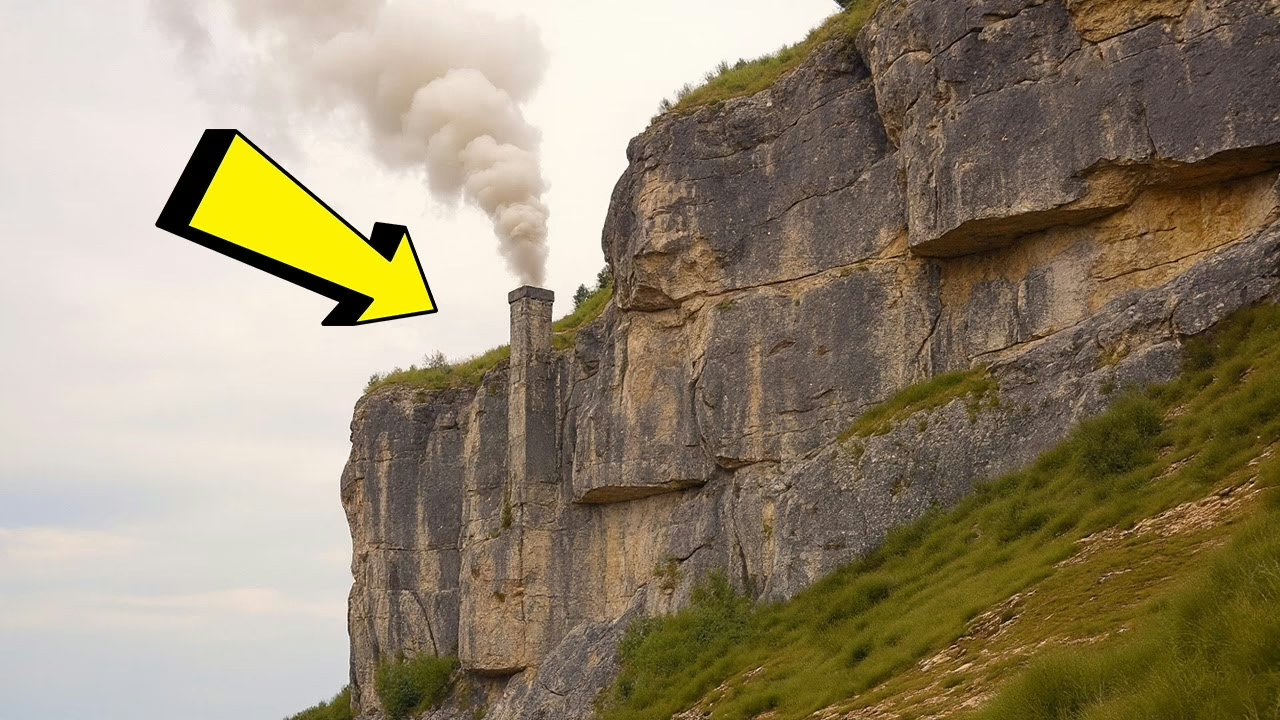
At first, it appeared almost unreal—a thin, steady column rising straight upward against the winter sky. It didn’t drift wildly or disperse as storm smoke might. It rose calmly, deliberately, as if it belonged there.
The problem was that it didn’t.
There were no cabins marked on their maps. No trails branching toward the cliff. No signs of human presence in that section of the mountain. Just rock, snow, and silence.
Leif, who led the group, raised his hand. Everyone stopped.
They followed the line of smoke with their eyes until it disappeared into a sheer rock face.
“A chimney?” someone suggested quietly.
The idea sounded absurd. And yet, no other explanation fit.
Choosing Curiosity Over Assumptions
They stood still for several moments, listening to the wind move gently along the ridge. Greta checked her gear, ruling out emergency signals or weather changes. Anna lifted her camera, capturing the thin line of smoke before it vanished into the blue.
Tom joked about folklore, but even he sounded unsure.
Leif felt a faint tension settle in his chest—not fear exactly, but the awareness that something unfamiliar was nearby. After a brief exchange, they agreed to investigate carefully.
A narrow, marked scramble led toward the cliff. Red paint on stones guided them upward, subtle but intentional. Whoever placed them expected visitors to arrive on foot, not by accident.
A Door in the Mountain
As they climbed, the fjord stretched wider beneath them, the horizon sharp and honest in the winter light. The smoke grew more distinct, its source now unmistakable.
It came from the rock itself.
Set into the cliff was a carefully constructed chimney, built of stone and brick, rising seamlessly from the mountain. Beneath it, partially sheltered by a ledge, stood a small wooden door.
The wind dropped suddenly as they reached it. The rock radiated a faint warmth, startling against the cold air. The scent reached them next—clean wood smoke, familiar and domestic, the kind associated with kitchens and long evenings indoors.
The door was simple but deliberate. Iron hinges. Carved wood. A small bell hanging from a leather strap.
Someone had meant for this place to be found.

Inside the Cliff
When the door opened, warmth spilled out immediately.
The interior was carved directly into the mountain, blending stone and wood without excess. Light filtered softly through windows cut into the rock, framing views of the fjord like paintings. Hooks for coats, a bench for boots, and a quiet sense of order greeted them.
A sign above an inner doorway bore a name that translated loosely to “the mountain coast.”
Footsteps echoed down the hall, and a woman appeared, smiling as if unexpected guests were not unexpected at all. She introduced herself as Elise and welcomed them inside, switching easily to English.
Coffee was already brewing.
A Place Built to Belong
As they warmed their hands around mugs, Elise explained the place.
It was a small, intentionally hidden lodge built into the mountain—not to dominate the landscape, but to cooperate with it. The rock acted as insulation and heat storage. Wood fires powered a network of chimneys, efficient and clean, visible by design.
“The chimney is honesty,” Elise said. “It tells you there is warmth here.”
There was no road, no large signage, no push to attract crowds. Visitors arrived on foot or not at all. Electricity was minimal. Comfort came from design, not excess.
Rooms lined the stone corridor—beds with wool blankets, shelves of books, handwoven rugs. Every element felt chosen rather than installed.
Hospitality Without Obligation
They were offered food without expectation, rest without pressure. Elise made it clear they could stay longer, return another day, or simply continue their hike.
The freedom felt intentional.
Over warm soup and bread, conversation slowed. The storm outside the mountain felt distant now. The place wasn’t a secret, exactly—but it wasn’t advertising itself either.
“It’s not hidden,” Elise said. “It just doesn’t ask to be found.”

Leaving With Something More Than Photos
Eventually, they stepped back into the cold.
The warmth lingered longer than expected, stored in stone, clothing, and memory. As they climbed higher, the lodge disappeared into the rock again, leaving only the chimney visible—one thin line against a vast white wall.
From the ridge, they paused. No one spoke for a while.
Leif realized the feeling he carried wasn’t excitement, but relief. Proof that people could exist in wild places without trying to conquer them. That building small, carefully, and respectfully was still possible.
They hadn’t discovered a secret.
They had found neighbors.
What the Smoke Meant
By the time they reached their car later that day, the chimney was no longer visible. That felt right. The mountain didn’t need to show everything at once.
That night, as wood smoke drifted from nearby cabins, Leif thought about how easily warmth could be recognized—by scent, by movement, by intention.
The lesson stayed simple:
Some places don’t belong to us.
But they are willing to share—if we arrive gently.