Throughout history, ships have carried explorers, merchants, soldiers, and valuable cargo across vast oceans and inland seas. While many voyages ended safely, others were lost to storms, navigation errors, or conflict. Centuries later, some of these lost vessels have resurfaced in surprising ways — offering important insights into trade, exploration, and global connections of the past.
Here are several historically documented shipwreck discoveries that have expanded our understanding of maritime history.
The Bom Jesus: A 16th-Century Ship Found in the Namibian Desert
In 2008, workers in a restricted diamond mining area along Namibia’s coast uncovered what initially appeared to be debris. Instead, archaeologists identified the remains of a Portuguese trading vessel known as the Bom Jesus, which disappeared in the early 1500s.
Evidence suggests the ship was likely traveling from Lisbon toward India when it encountered severe weather near the southern coast of Africa. It appears to have struck rocks close to shore and broken apart.
Key Discoveries from the Site
Archaeologists documented:
- Over 1,800 copper ingots weighing approximately 16–17 tons
- More than 2,000 gold and silver coins from multiple regions
- 105 elephant tusks weighing about two tons
- Cannons, swords, navigational tools, and trade goods
The copper ingots were traced to a wealthy European trading company based on identifiable markings. DNA testing on the tusks indicated they originated from West African elephant populations.
Because the site was located in a restricted mining zone, it remained undisturbed for centuries. Thick layers of sand helped preserve many of the materials.
Today, the Bom Jesus is considered one of the oldest and most valuable shipwrecks discovered along the western coast of sub-Saharan Africa.
A Merchant Ship Revealed by Shifting Sand Near the Caspian Sea
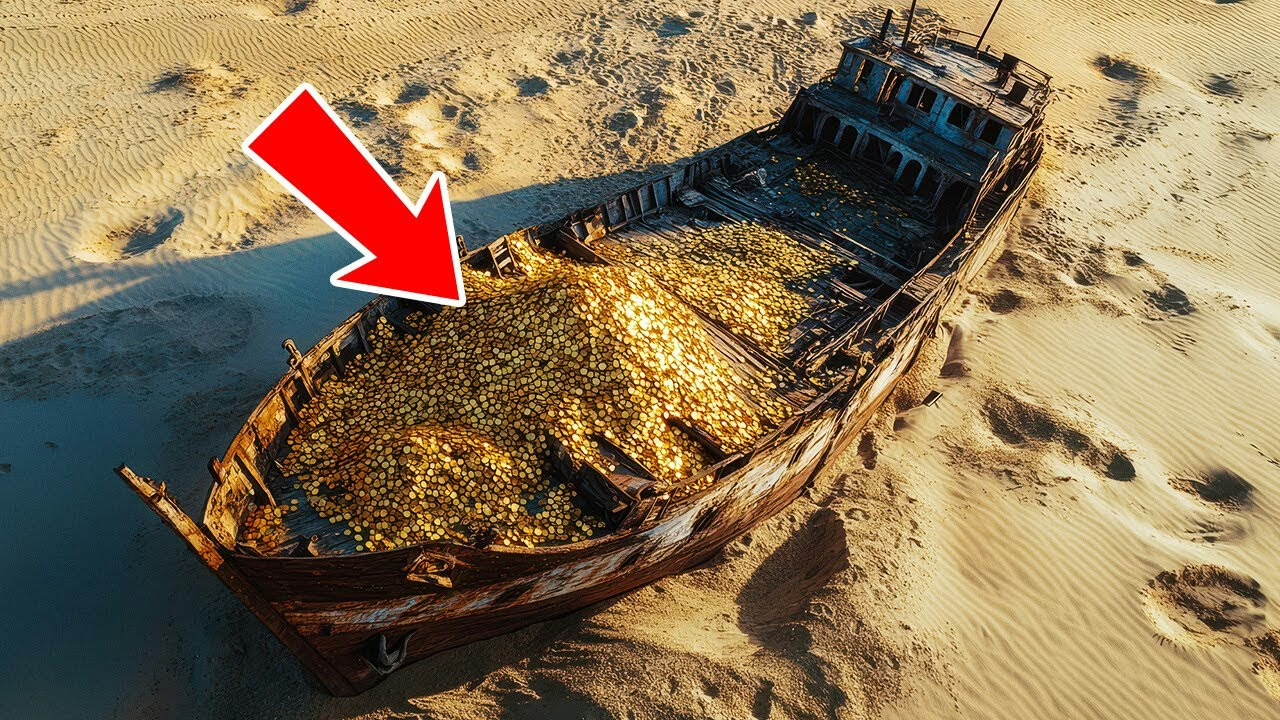
Changes in water levels near the Caspian Sea gradually exposed a large wooden vessel that had been buried under a tall sand dune.
Archaeologists identified it as a three-masted merchant ship measuring roughly 92 feet in length. Wood analysis indicated it was constructed between the 18th and 19th centuries using regional timber such as Scots pine, spruce, and larch.
Plant remains, including buckwheat, were also discovered, suggesting the ship was involved in regional trade or carried provisions for long journeys.
To protect the vessel from wave damage during excavation, researchers constructed a temporary barrier using sandbags. The discovery provides insight into commercial activity in the Caspian region during that era.
A Black Sea Discovery Linked to Early 20th-Century Maritime History
Off the coast of Turkey, an amateur fisherman captured underwater footage of large metal remains roughly 20 feet below the surface.
Marine experts later determined the structure likely dates to the early 20th century and could be associated with vessels operating during the final years of the Ottoman Empire.
Because the wreck is in fragile condition, researchers are using careful documentation methods and historical shipyard records to better understand its origin.
A 3,300-Year-Old Mediterranean Shipwreck
Robotic submersibles operating in the eastern Mediterranean identified hundreds of intact ancient storage jars resting on the seabed.
Experts estimate the shipwreck dates back approximately 3,300 years, making it one of the oldest deep-sea wrecks documented to date.
The ceramic jars were likely used to transport goods such as oil or agricultural products. This discovery suggests advanced maritime trade routes existed in the Late Bronze Age and that ancient sailors navigated open waters using celestial navigation techniques.
A 2,500-Year-Old Ship Near Sicily
Off the coast of Sicily, archaeologists uncovered a shipwreck buried under layers of sand and rock. Dating suggests it may originate from the 5th or 6th century BCE.
The ship appears to have been built using the “on-shell” technique, where wooden planks were tightly joined before internal reinforcements were added. Nearby, researchers also found ancient stone and iron anchors from various historical periods.
The discovery sheds light on early Mediterranean trade networks during a time when Greek and Punic civilizations competed for maritime influence.
A Shipwreck Off Kenya Possibly Linked to Vasco da Gama’s Era
In 2013, local fishermen off the coast of Kenya discovered underwater remains that archaeologists later examined. Artifacts such as copper ingots and elephant tusks were recovered.
Some researchers have explored whether the wreck could be connected to the period of Portuguese exploration in the Indian Ocean, potentially dating to the 16th century. However, further study is required to confirm specific historical links.
Much of the structure remains buried under coral, and investigations are ongoing.
Why Shipwreck Discoveries Matter
Shipwrecks are more than lost vessels — they are time capsules. They help historians understand:
- Ancient trade networks
- Maritime engineering techniques
- Cultural exchanges between regions
- Economic systems and resource distribution
- Navigation and exploration methods
Modern technologies such as sonar mapping, underwater robotics, and carbon dating allow researchers to examine sites with increasing precision while preserving fragile remains.
A Window Into Global History
From the deserts of Namibia to the depths of the Mediterranean and the shores of East Africa, these discoveries highlight how interconnected ancient and early modern societies were.
Each shipwreck adds context to historical records, providing physical evidence of trade routes, materials exchanged, and the technological capabilities of their time.
As underwater archaeology continues to develop, more findings may emerge — offering further insights into humanity’s long relationship with the sea.
All historical interpretations in this article are based on documented archaeological findings and ongoing academic research.