
At first, it looked like nothing.
Just a dead patch of forest where the air felt strangely flat. No birdsong. No insects. Even the wind seemed to pass around it instead of through it. The kind of place hikers notice without knowing why — and then try to ignore.
Jon almost did.
He had been walking for hours, boots steady against the dirt trail, following a route he’d taken before. The forest was familiar. Predictable. Safe.
Until it wasn’t.

A Shape That Didn’t Belong
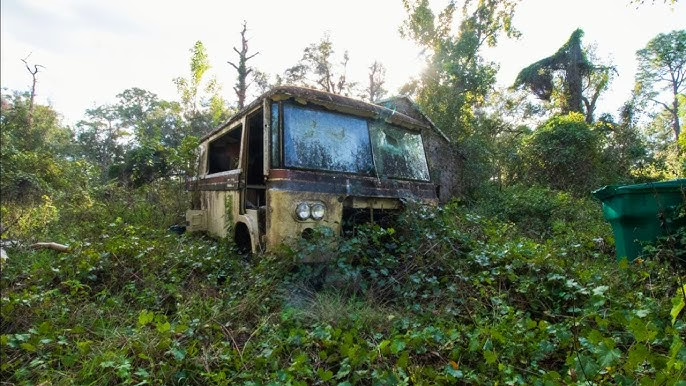
Through the trees, half-swallowed by branches and shadow, sat a camper.
Not parked.
Not placed.
Abandoned.
It leaned slightly to one side, one tire sinking low into the soil. The paint was blistered and peeling. The windows were dark, reflective, unreadable. Branches pressed against the frame as if the forest had been slowly trying to reclaim it for months.
He would’ve kept walking.
But then he noticed the door.
It wasn’t closed.
It wasn’t open either.
Just slightly ajar.
Enough to feel wrong.
The Silence Was Intentional
Jon stood there longer than he should have, listening.
No voices.
No movement.
Only the faint metallic tap of something loose inside shifting with the wind.
The forest around him remained unnaturally quiet.
When he stepped closer, the smell reached him first.
Old plastic.
Stale fabric.
And beneath it, something sharp and chemical — something that didn’t belong in open air.
He pushed the door.
It creaked once.
Loud.
Too loud.
He froze.
Inside the Camper
His flashlight cut through the darkness.
Blankets.
Torn bags.
Empty cans.
Dust.
At first glance, it was just clutter.
But the longer he looked, the more something felt off.
The mess wasn’t random.
Items were lined up. Carefully arranged. Placed with intention.
It looked like someone had staged disorder.
Like someone had been living there — and didn’t want it to look that way.
Jon stepped one foot inside.
The floor dipped beneath him.
From deeper inside the camper came a sound.
Not an animal.
Not the wind.
A small, controlled shift.
He held his breath.

The Seam in the Wall
At the back, a ripped curtain hung in a tight knot.
He didn’t touch it.
Instead, his flashlight moved along the walls.
And then he saw it.
A panel seam.
Not factory.
Not original.
A thin, uneven line where the wall material didn’t match. Screws that didn’t belong.
Campers don’t grow new hardware on their own.
His stomach tightened.
That’s when he noticed something else.
Footprints
Outside the door, the ground was bare.
No weeds.
No undergrowth.
Just trampled earth.
Multiple footprints.
Fresh enough that the edges hadn’t softened.
Someone had been coming here.
Recently.
He pulled out his phone.
One bar.
Then two.
His thumb hovered.
Maybe it’s nothing.
Then his light caught a heavy-duty bag tucked beneath the front seat. Sealed tight. Hidden carefully.
He didn’t open it.
Didn’t touch it.
He turned and walked fast — back to the trail, back to open space.
And then he called.

The Officers Arrived Quietly
They didn’t roll in loud.
No sirens.
No dramatic shouting.
They parked out of sight and walked in slow.
The first question they asked him wasn’t about what he saw.
It was:
“Where did you step? What did you touch?”
“Nothing,” Jon said. “I didn’t touch anything.”
They nodded.
Two officers stayed outside, scanning the tree line.
Inside, they moved carefully.
They removed the first sealed bag.
They didn’t open it.
They didn’t smell it.
They handled it like it could harm them without warning.
Then another.
Then another.
Then wrapped items hidden where hikers would never look.
One officer pressed the seam Jon had seen.
The wall shifted.
Just slightly.
Enough.
A false compartment.
Not built for camping gear.
Built for storage.
Temporary storage.
The Forest Changed Again
Jon stood back on the trail where they told him to wait.
He watched.
The officers didn’t react with shock.
They reacted with restraint.
This wasn’t new to them.
This wasn’t curiosity.
It was containment.
More bags came out.
Marked.
Sealed.
Placed carefully on the ground.
Each one positioned like it mattered which direction it faced.
Then the radio crackled.
One clipped sentence.
The tone shifted.
Not discovery.
Concern.
It Was Active
The officers widened their spacing.
One circled the camper.
One stayed at the door.
One moved toward the trail.
They weren’t just investigating.
They were preparing.
Jon realized something terrifying.
The camper wasn’t abandoned.
It was active.
A drop point.
A temporary hide.
A place someone visited — not lived in.
Which meant there was a schedule.
Maybe today.
Maybe tonight.
The Sound in the Trees
They moved Jon farther back along the trail.
That’s when he heard it.
Faint.
Far off.
An engine.
Not a car on pavement.
Something smaller.
Something that could move where roads didn’t exist.
It lasted seconds.
Then vanished.
The officers heard it too.
You could tell by the way their heads turned at the same time.
One spoke into the radio again.
Short.
Controlled.
Jon didn’t move.
The forest looked normal again.
But it didn’t feel normal.

More Than Just Hidden Storage
Inside the camper, they found more.
Not clutter.
Structure.
A compartment behind a cabinet.
A false bottom beneath the floor.
Crude but purposeful.
Built to hold items long enough to move them later.
An officer approached Jon.
“You did the right thing calling.”
“What is it?” Jon asked.
The officer didn’t answer directly.
“This isn’t camping gear.”
Then, quietly:
“Don’t tell anyone where this is.”
That sentence hit harder than anything else.
Because it meant the danger wasn’t over.
It was simply being handled quietly.
The Chain
More vehicles arrived later.
Unmarked.
Protective gear.
Gloves.
Sealed containers.
They treated the camper like it could bite.
They documented everything.
Angles.
Ground.
Tree line.
Not because the camper itself mattered.
But because it was connected.
Places like that don’t exist alone.
They’re links.
And links lead somewhere.
After
Jon gave his statement again and again.
How long he’d been hiking.
Where he turned off the path.
What he smelled.
What he saw.
What he touched.
“Nothing,” he kept saying.
The forest eventually looked ordinary again.
Same trees.
Same filtered light.
Same quiet.
But he couldn’t unsee it.
The slightly open door.
The seam in the wall.
The fresh footprints.
The sealed bag.
The engine in the distance.
And the worst part wasn’t what was inside the camper.
It was how close he came to staying longer.
Because if he had waited.
If he had stepped fully inside.
If he had tried to look behind that curtain.
He might not have been the one making the call.
Why This Story Matters
Sometimes the most dangerous places don’t look dangerous.
They look abandoned.
Silent.
Forgotten.
And sometimes the difference between walking away and not walking away is a single decision.
Jon trusted the feeling that something was wrong.
And that decision may have saved more than just himself.
The forest went back to being quiet.
But now we know:
Silence doesn’t always mean empty.