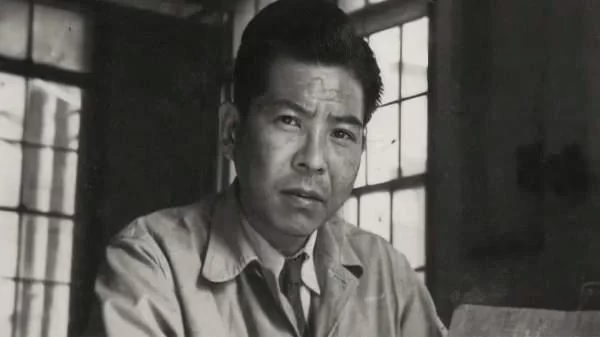
History records moments so destructive that surviving them once seems impossible. Surviving them twice sounds like a myth. Yet in the chaos of World War II, one man experienced the unthinkable—not once, but two times—and lived long enough to tell the story.
His name was Tsutomu Yamaguchi.
And his life became one of the most haunting testaments to human endurance ever documented.
A Routine Trip That Turned Into Hell
In the summer of 1945, Yamaguchi was a 29-year-old naval engineer working for Mitsubishi Heavy Industries. He was on a business trip to Hiroshima, inspecting oil tanker designs for the Japanese military. The war was nearing its end, though few knew it at the time.
On the morning of August 6, 1945, Yamaguchi was preparing to leave the city when he noticed a lone American B-29 bomber overhead. Moments later, the sky exploded.
A blinding white flash swallowed everything.
Yamaguchi was thrown violently to the ground. The shockwave ruptured his eardrums and burned the upper half of his body. Buildings collapsed. Fires erupted. The city of Hiroshima ceased to exist in a single instant.
Walking Through a World That Had Ended
Despite severe burns and temporary blindness, Yamaguchi survived the initial blast. He stumbled through the ruins, witnessing scenes that would haunt him for the rest of his life—people with skin hanging from their bodies, shadows burned permanently into walls, entire neighborhoods erased.
That night, he took shelter in a makeshift hospital. Against all odds, he was still alive.
Two days later, barely able to walk, Yamaguchi boarded a train back home to Nagasaki.
He believed he had escaped the worst disaster imaginable.
He was wrong.
The Second Explosion No One Could Believe
On August 9, 1945, just three days after Hiroshima, Yamaguchi reported to work in Nagasaki. While describing the Hiroshima blast to his supervisor—trying to explain how a single bomb had destroyed an entire city—the air raid sirens sounded.
Once again, a blinding flash filled the sky.
The second atomic bomb detonated over Nagasaki.
Yamaguchi survived again.
Protected by a concrete building, he avoided the full force of the blast, though radiation and injuries compounded his already weakened condition. His home was damaged, but his wife and newborn son survived after being thrown into a ditch by the shockwave.
Two cities.
Two atomic bombs.
One human being caught in both.
The Weight of Survival
In the years that followed, Yamaguchi suffered radiation sickness, hair loss, chronic fatigue, and long-term health issues. His wife later developed liver and kidney problems believed to be caused by radiation exposure. Their son endured lifelong health complications.
But perhaps the greatest burden was psychological.
Yamaguchi carried memories no one else around him could truly share. He struggled with survivor’s guilt, haunted by the millions who never had the chance he did.
For decades, he rarely spoke publicly about his experiences.
Official Recognition—and a Voice Found Late
In 2009, the Japanese government officially recognized Tsutomu Yamaguchi as a nijū hibakusha—a survivor of both atomic bombings. He was the only person ever to receive that status.
By then, Yamaguchi had found his voice.
He began speaking out against nuclear weapons, urging the world to understand the human cost behind political decisions and military power. He testified at the United Nations, sharing his story so future generations would never forget what atomic warfare truly means.
He didn’t speak with hatred.
He spoke with warning.
More Than a Miracle Story
Yamaguchi’s survival is often framed as extraordinary luck. But to reduce his life to chance misses the point.
His story reveals something deeper:
- How fragile human civilization truly is
- How close humanity came to destroying itself
- How one individual can become living proof of history’s darkest chapter
He was not immune to suffering.
He was not untouched by tragedy.
He simply endured.
A Legacy Written in Ash and Memory
Tsutomu Yamaguchi died in 2010 at the age of 93. He lived long enough to see the world move further away from nuclear war—but not far enough.
Today, his story stands as both a miracle and a warning.
He survived two atomic bombs, not to amaze the world, but to remind it.
Survival does not erase responsibility. And remembering is the first step toward ensuring such destruction never happens again.
His life is proof that even in humanity’s darkest moments, a single voice can carry the weight of history—and still choose hope.